A tooth doesn’t hurt for no reason. The ache that keeps coming back when you bite down, the cold sensitivity that lingers a beat longer than it used to – these aren’t things that sort themselves out. Most people who end up needing a root canal spent several weeks wondering whether what they were feeling was bad enough to act on. By the time they came in, it usually was.
Root canals carry a reputation built almost entirely on outdated information. The procedure is what ends the pain, not what causes it – most patients are genuinely surprised by how routine the experience is compared to what they’d imagined.
When It’s a Dental Emergency vs. When You Can Wait
Some situations don’t belong in a symptom checklist – they need same-day care or an emergency room. Check these first.
If any of the following apply, call for same-day care. If your dental office is closed, go to an emergency room.
- Swelling extending into the face, neck, or floor of the mouth – Once swelling moves beyond the jaw, it can compromise breathing or swallowing. Emergency care, not a dental appointment.
- Fever alongside tooth pain – A fever means your body is fighting something that’s moved beyond the tooth itself. That combination doesn’t wait for a scheduled opening.
- Pus or discharge from the gum that won’t stop – Ongoing drainage is an active infection finding a way out. Same-day assessment, not a booked slot.
- Uncontrolled pain – If ibuprofen and acetaminophen aren’t making a dent, act on that today. Waiting for a routine appointment to open isn’t the answer.
- Difficulty opening your mouth, swallowing, or breathing – Emergency room. This has moved past what a dental office handles.
If none of those apply, read through the symptom list below. Note what fits your situation and get an appointment on the calendar – a week’s delay is usually fine; a month’s usually isn’t.
7 Symptoms of Needing a Root Canal
These warning signs don’t always cluster together – one or two is often all a patient notices, at least until things progress. What matters isn’t severity so much as duration. Any symptom that’s been around for more than a few days deserves a professional opinion, even when the pain is still manageable.
1. Lingering or Persistent Tooth Pain
A deep, throbbing ache that doesn’t ease after the trigger is gone – that’s the pattern worth taking seriously. Normal sensitivity flares and fades within seconds. An infected pulp doesn’t give you that relief. The ache stays for minutes, sometimes hours, and for some people it becomes constant before they finally call.
This kind of pain can spread into your jaw, nearby teeth, or your ear, and it tends to worsen when you bite down. Don’t dismiss it as a sinus issue or stress response – neither of those produces this kind of localized, sustained discomfort. Get it checked.
2. Prolonged Sensitivity to Heat or Cold
The clinical distinction isn’t whether a tooth reacts to hot or cold food – it’s how long that reaction lasts. A healthy tooth flinches and recovers in seconds. When the response lingers well past the trigger – 30 seconds, a minute, longer – that extended reaction points to inflamed or compromised nerves inside the tooth. In many cases, this is the earliest sign of pulp involvement, appearing before the more obvious symptoms arrive.
3. Tooth Darkening or Discolouration
A tooth that’s gone grey, brown, or noticeably darker than its neighbours – without obvious cause like staining from coffee or tea – may be dying internally. When the pulp is infected or the blood supply is cut off, the tissue inside begins to break down, and that breakdown shows through the enamel as discolouration.
Most people file this under cosmetics and move on. That’s worth resisting. A darkening tooth reflects internal damage that will keep progressing, and the window for catching it early doesn’t stay open.
4. Swelling in the Gum or Jaw
Localized tenderness, puffiness in the gum tissue, or a visibly swollen jaw around a tooth – these point to infection. Dental abscesses spread. The tissue between teeth and jaw doesn’t form a reliable barrier against bacteria, so swelling paired with tooth pain is taken seriously rather than monitored from home.
If that swelling moves into your face or neck, or if you’re having any difficulty swallowing or breathing, skip the appointment queue entirely and go to emergency care. That situation has moved past dental triage.
5. A Pimple or Bump on the Gum
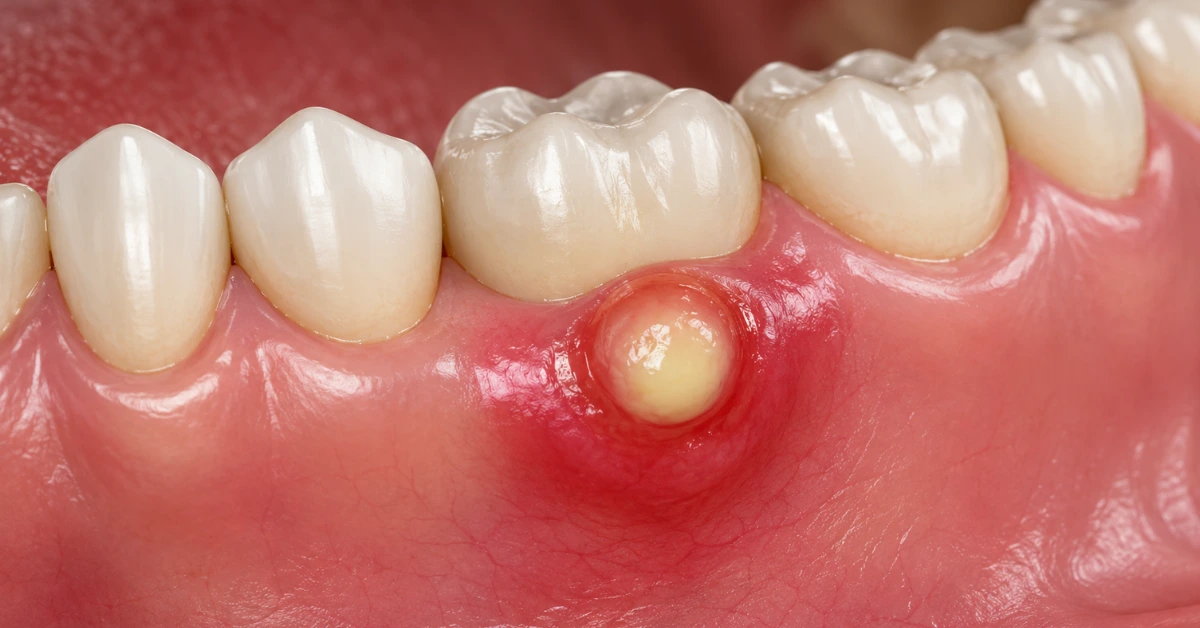
Near a painful tooth, a small pimple-like bump on the gum is a dental fistula – sometimes called a sinus tract. It forms when infection builds enough pressure that the tissue creates a drainage channel. You might notice a bad taste in your mouth when it’s active, or that the bump appears and disappears without explanation.
Some patients feel brief relief when this happens and assume the problem is resolved. It hasn’t. The fistula is a sign the infection is still active – root canal treatment is almost always indicated at this point, even when the acute discomfort has quieted down.
6. A Cracked or Fractured Tooth
Cracks in teeth aren’t always visible to the naked eye. Hairline fractures can run deep into or near the pulp, exposing it to bacteria with every bite. If you have a tooth that cracked in an accident, a sports injury, or from something as ordinary as biting into ice – and that tooth has since become sensitive or painful – the pulp may already be affected.
Not every cracked tooth ends up needing a root canal, to be fair. It depends entirely on how deep the crack goes. But if it reaches the pulp, or if symptoms suggest infection has set in, the treatment path usually includes one. Our guide on cracked tooth after root canal – essential steps to take covers what comes after.
7. Deep Decay That Has Reached the Pulp
A cavity left untreated long enough stops being a cavity. When decay reaches the inner pulp – the soft tissue containing nerves and blood vessels – a filling no longer addresses the problem. The infected tissue has to come out, the canals get cleaned, and the tooth gets sealed. There isn’t a simpler version of it at that stage.
Deep decay often shows on X-rays before obvious symptoms appear, which is a concrete reason regular check-ups matter. If you’ve had a cavity that never got treated, or one that’s been breaking down over time, get it assessed before pain makes the decision for you.
What Happens If You Ignore These Symptoms
Dental pulp infection doesn’t resolve on its own. Antibiotics can temporarily reduce bacterial load, but they can’t clear infection from inside a tooth with no blood supply to carry the medication. The infection stays, and the situation follows a fairly consistent progression.
An abscess forms first – a pocket of pus at the root tip that can be acutely painful, or in some cases surprisingly quiet until it ruptures. The quiet version is not the safer version. As the infection continues, it erodes the surrounding bone. This shows on X-rays, and if it progresses far enough, it destabilizes teeth adjacent to the infected one – not just the tooth itself.
From there, bacterial spread becomes a real possibility. A tooth that looked fine at your last appointment can become involved if an untreated infection has been sitting next to it long enough. In serious cases, infection moves past the jaw entirely. Ludwig’s angina – a life-threatening condition affecting the floor of the mouth – traces back to untreated dental abscesses. Rare, but documented and not theoretical.
The end of this path is tooth loss. A tooth that could have been saved with a root canal becomes non-restorable and requires extraction. Extractions carry their own chain of consequences: adjacent teeth shift, bone at the extraction site deteriorates over time, and a replacement becomes necessary. Implants are very good – they’re not the same as keeping the original tooth. Root canal treatment, when the tooth is still restorable, keeps the natural tooth in place. That outcome is almost always worth pursuing.
For more on the risks specific to abscessed teeth, see our article on the dangers of pulling an abscessed tooth. For the financial comparison between root canal treatment and extraction plus replacement, see our breakdown of root canal cost.
What a Root Canal Actually Involves
The procedure’s reputation is roughly 40 years out of date. When you’re fully numbed, root canal treatment is no more uncomfortable than a filling placed on a back molar. The scope of the work is greater – the pain level during the appointment is the same.
The steps, in order:
- Diagnosis and X-ray – Before anything else, your dentist maps what’s happening: the extent of infection, canal shape, and whether surrounding bone is involved. Treatment follows from those findings, not from a standard script.
- Local anaesthetic – The area is fully numbed before anything begins. Acutely infected teeth can be harder to fully anaesthetize – when that happens, your dentist works through it rather than pressing on. Most patients are surprised by how much this step is prioritized.
- Access, cleaning, and shaping – A small opening in the crown gives access to the pulp chamber. Infected tissue comes out, the canals get shaped, and antimicrobial irrigation clears the bacterial load. This is the part of the procedure that actually resolves the infection.
- Filling the canals – Gutta-percha, a biocompatible rubber-like material, seals the cleaned canals. That seal is what keeps the infection from returning.
- Restoration – A crown goes on most root canal-treated teeth once the procedure is done. It protects what’s left of the natural structure and brings the tooth back to full function. Your dentist will go over the plan before you leave.
One to two appointments cover it for most cases. Mild soreness in the area for a few days afterward is normal – surrounding tissue settling as the inflammation clears. Most patients are back to their regular schedule the same day. The Dental Team’s offices in Milton, Mississauga, and Brampton use the same clinical approach; if you want a walkthrough of what to expect at your specific location before anything starts, the team will go through it with you.
Frequently Asked Questions
How do I know if my tooth pain is a root canal or something else?
Root canal pain tends to be deep, throbbing, and unrelenting – it doesn’t ease once the trigger is removed. A cracked tooth, gum infection, or sinus pressure can produce similar sensations. A clinical exam and X-ray are what actually confirm the cause; symptoms alone aren’t diagnostic. If pain has lasted more than a few days or comes with swelling, book an appointment rather than waiting it out.
Can a root canal fail?
Root canal treatment has a high success rate, but no procedure is guaranteed. Complex root anatomy or a particularly stubborn bacterial strain can result in a tooth that needs retreatment. Signs include returning pain, new swelling near the treated tooth, or a recurring fistula. An assessment determines whether retreatment is viable or a different approach is needed.
Is a root canal covered under the Canadian Dental Care Plan?
Coverage under the Canadian Dental Care Plan (CDCP) depends on household income and the specific procedure. Root canal treatment on anterior (front) teeth is generally included. Coverage for molars may be more limited. Co-payments by income tier: 0% for income under $70,000, 40% at $70,000 – $79,999, and 60% at $80,000 – $89,999. The Dental Team offices in Milton, Mississauga, and Brampton accept CDCP patients – confirm your specific coverage when booking.
How long does recovery take after a root canal?
Most patients feel significantly better within two to three days. Mild soreness in the area is normal for up to a week. Avoid chewing hard foods on the treated side until your crown is placed. If pain is increasing after the first few days rather than easing off, that’s worth a call to your dentist – it shouldn’t be heading in that direction.
What’s the difference between a root canal and an extraction?
A root canal removes infected tissue while keeping the natural tooth in place. An extraction removes the tooth entirely. Both address the infection, but extraction creates a gap that usually needs to be filled – with a dental implant, bridge, or similar – to prevent adjacent teeth from shifting over time. When the tooth structure is still restorable, keeping it is almost always the better path. Your dentist will advise on which applies to your situation.
Book an Evaluation at The Dental Team
If you’re in acute pain right now, or if any of the emergency symptoms above apply to you, contact The Dental Team for same-day care. The offices in Milton, Mississauga, and Brampton see emergency dental patients and will work to get you in as quickly as possible.
If your symptoms are uncomfortable but not at that level, book a consultation. A clinical exam and X-ray will tell you exactly what’s happening – and the sooner that happens, the more options remain on the table. A tooth that’s restorable today doesn’t stay that way indefinitely.
Explore our full range of dental services or contact The Dental Team for more information.