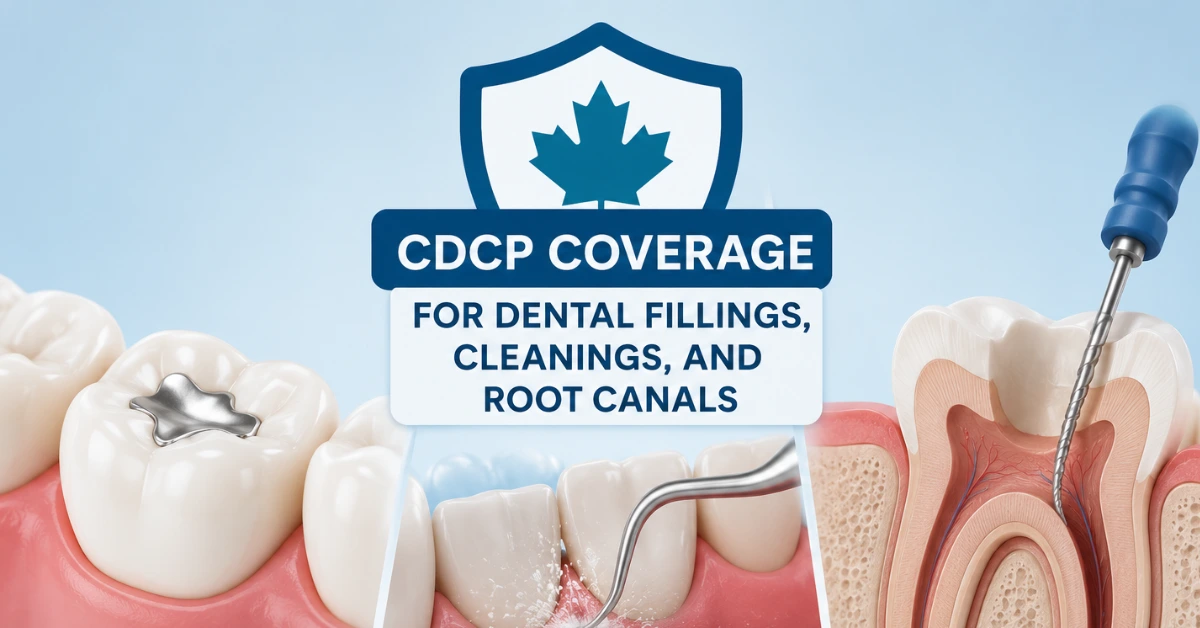
A root canal in Ontario costs between $700 and $2,100 for the procedure itself, depending on which tooth is being treated. Front teeth sit at the lower end of that range, while back molars sit at the higher end because they have more canals to clean and seal. Add the dental crown that most teeth require afterward, and the total investment runs from $1,900 to $4,100. Ontario dentists use the Ontario Dental Association (ODA) fee guide as a pricing benchmark, though individual clinics set their own rates.
That range is a starting point, not a final number. Whether a general dentist or an endodontist performs the procedure, how severe the infection is, whether sedation is involved, and what your insurance or Canadian Dental Care Plan (CDCP) coverage pays out will all shift what you actually owe. Most patients are also surprised to learn that pulling the tooth instead of saving it typically costs more in the long run once a replacement is factored in.
If you’ve been told you need a root canal and you’re in the Milton, Mississauga, Brampton, or Vaughan area, The Dental Team offers root canal treatment across all GTA locations, with same-day emergency appointments, both general dentists and endodontists on staff, and a written cost estimate before any treatment begins. Here’s everything you need to know about root canal costs in Ontario before you book.
How Much Does a Root Canal Cost in Ontario by Tooth Type?
Root canal cost in Ontario is determined primarily by which tooth needs treatment. The more canals a tooth has, the longer the procedure takes and the higher the fee. The ODA fee guide provides the pricing framework most Ontario dentists use as a starting point.
| Tooth Type | 2026 Cost Range | Number of Canals | Treatment Time |
|---|---|---|---|
| Front Teeth (Incisors/Canines) | $700–$2,100 | 1 canal | 45–60 minutes |
| Bicuspids (Premolars) | $900–$1,600 | 1–2 canals | 60–75 minutes |
| Molars (Back Teeth) | $1,300–$2,100 | 3–4 canals | 75–90 minutes |
These figures cover the root canal procedure only – cleaning out the infected pulp, disinfecting the canals, and sealing the tooth. They do not include the dental crown that’s typically required two to four weeks after the procedure to protect the weakened tooth structure.
Dental crowns in Ontario cost an additional $1,200 to $2,000 in 2026, depending on the material chosen (porcelain, zirconia, or porcelain-fused-to-metal). Combined with the procedure cost, the total to save a single tooth runs from $1,900 to $4,100.
Does the Cost Change With a General Dentist vs. Endodontist?
Yes, root canal cost in Ontario increases when the procedure is performed by an endodontist rather than a general dentist. Endodontists are specialists who completed two to three additional years of training focused exclusively on root canal treatment. Their fees typically run 20 to 40% higher than those of a general dentist.
| Tooth Type | General Dentist (Ontario) | Endodontist (Ontario) |
|---|---|---|
| Front teeth | $700 to $1,200 | $900 to $1,500 |
| Premolars | $900 to $1,400 | $1,100 to $1,700 |
| Molars | $1,300 to $2,100 | $1,600 to $2,500 |
General dentists handle the majority of root canals successfully. Endodontists are brought in for complex cases – curved or calcified canals, retreatment of a failed root canal, severe infections that have spread to surrounding bone, or teeth with unusual anatomy.
If your dentist refers you to an endodontist, it means the case warrants that level of expertise. Declining the referral to save money often leads to treatment failure and eventual tooth loss, which costs considerably more to address.
The Dental Team has both general dentists and endodontists on staff across GTA locations, so complex cases are handled in-house without external referrals.
What Does a Root Canal Quote Actually Include?
A root canal quote from an Ontario dental office should be itemized, covering each component of the treatment separately. Understanding what each line item represents helps you avoid surprises and makes it easier to verify what your insurance or CDCP will cover.
| Service Component | What It Covers | Typical Cost Range |
|---|---|---|
| Diagnostic examination | Consultation, X-rays, and assessment of infection severity | $75 to $200 |
| Local anesthesia | Numbing medication for comfort during the procedure | $50 to $150 |
| Root canal procedure | Cleaning, disinfecting, and sealing the canals | $700 to $2,100 (by tooth type) |
| Post and core build-up | Structural reinforcement if the tooth needs support before a crown | $150 to $300 |
| Dental crown | Protective restoration placed after the root canal | $1,200 to $2,000 |
| Follow-up appointment | Post-treatment check, sensitivity review, and X-ray confirmation | $50 to $150 |
Before any treatment begins, ask your dental office for a written estimate that includes procedure codes. You can use those codes to verify coverage with your insurer or submit a pre-authorization request to CDCP, which confirms exactly what will be covered before you commit to treatment.
The Dental Team provides written estimates with full itemization at every location before any work starts.
How Much Does a Root Canal Cost Without Insurance in Ontario?
Without insurance, a root canal in Ontario costs between $700 and $2,100 for the procedure, plus $1,200 to $2,000 for the crown, for a total of $1,900 to $4,100 out of pocket depending on the tooth and the clinic.
If that number is a barrier, there are several options worth knowing before you delay treatment:
- Check CDCP eligibility first. If your adjusted family net income is under $90,000 and you don’t have private dental insurance, you may qualify for the Canadian Dental Care Plan, which can cover 40 to 100% of the procedure cost. The section below covers eligibility in full.
- Ask about payment plans. Many Ontario dental offices, including The Dental Team, offer monthly installment options that spread the cost over 8 to 12 months without requiring payment in full upfront.
- Consider third-party financing. Healthcare financing providers like PayBright and iFinance offer approved credit plans. Zero-interest options exist but typically require full repayment within 6 to 12 months, so read the terms carefully.
- University dental clinics. The University of Toronto Faculty of Dentistry offers root canal treatment performed by supervised students at 40 to 60% below private practice fees. Wait times are longer and appointments run slower, but the clinical quality is supervised and sound.
Delaying a root canal to manage cost almost always increases the final bill. Infections that spread require more complex treatment, longer appointments, and sometimes specialist involvement that a simpler early-stage case would not have needed. Understanding the full dentist appointment cost in Ontario is a good starting point before factoring in more complex treatment.
Does Dental Insurance Cover Root Canals in Ontario?
Yes, most private dental insurance plans in Ontario cover root canals, but the coverage percentage and annual maximums vary significantly by plan tier. Root canals are typically classified as a major restorative procedure, which carries lower reimbursement rates than preventive care.
Here’s how coverage typically breaks down by plan type:
- Basic plans – Cover 50% of major restorative procedures up to an annual maximum of $1,000 to $1,500
- Mid-tier plans – Cover 60 to 70% up to an annual maximum of $1,500 to $2,000
- Comprehensive plans – Cover 80% up to an annual maximum of $2,500 or more
Two details catch patients off guard. First, most plans reimburse based on ODA fee guide rates, not what your dentist actually charges. If your dentist bills above the guide, you pay the difference on top of your co-payment. Second, many plans have waiting periods of 3 to 12 months for major procedures after enrollment. If you recently changed jobs or started a new plan, confirm whether your coverage has activated before booking treatment.
The Dental Team offers direct billing with most major Ontario insurance carriers. Coverage is verified before treatment begins so you know your out-of-pocket amount in advance.
Can the Canadian Dental Care Plan (CDCP) Cover My Root Canal?
Yes, the Canadian Dental Care Plan covers root canal treatment for eligible Canadians who do not have access to private dental insurance. As of 2026, the CDCP is available to anyone in a household with an adjusted family net income below $90,000 who meets the eligibility criteria.
Your co-payment level is determined by your household income:
| Adjusted Family Net Income | CDCP Covers | Your Co-payment |
|---|---|---|
| Under $70,000 | 100% | $0 |
| $70,000 to $79,999 | 60% | 40% |
| $80,000 to $89,999 | 40% | 60% |
For a $1,500 molar root canal, a household earning under $70,000 pays nothing. A household earning $75,000 pays $600. A household earning $85,000 pays $900.
There are a few important limitations to understand before booking:
- Crown coverage requires separate approval. CDCP covers crowns only when clinically necessary. Your dentist must submit a treatment plan justifying the crown before the plan will cover it.
- Balance billing may apply. CDCP pays based on its own fee schedule, which is often lower than what Ontario clinics charge. The gap between the CDCP rate and your dentist’s rate is billed directly to you on top of any co-payment.
- Not all dentists participate. Confirm CDCP participation when booking. The Dental Team accepts CDCP at all GTA locations and verifies coverage before treatment begins.
- Renewals are annual. CDCP coverage must be renewed each year through canada.ca/dental after filing your tax return.
Is It Cheaper to Pull the Tooth Than Get a Root Canal?
Tooth extraction costs less upfront, but replacing the missing tooth almost always costs more than saving it with a root canal. Most patients don’t realize this until after the extraction, when the long-term bill becomes clear.
| Option | Upfront Cost | Replacement/Additional Cost | Total Estimated Cost |
|---|---|---|---|
| Root canal + crown | $1,900 to $4,100 | None | $1,900 to $4,100 |
| Extraction + dental implant | $200 to $400 | $3,000 to $5,000 | $3,200 to $5,400 |
| Extraction + dental bridge | $200 to $400 | $2,500 to $4,000 | $2,700 to $4,400 |
| Extraction + partial denture | $200 to $400 | $1,200 to $3,000 | $1,400 to $3,400 |
Even the cheapest replacement option – a partial denture – often costs as much as a root canal and crown, and requires removal for daily cleaning, can shift when eating, and needs replacement every five to seven years.
There’s also a biological cost that no price table captures. Your natural tooth root stimulates the jawbone. Once a tooth is extracted, the bone in that area begins breaking down within three to six months. Surrounding teeth can drift into the gap, throwing off your bite and creating a cascade of further dental problems over time.
A root canal preserves the tooth, the root, and the bone. For most patients with a salvageable tooth, it is the more economical and healthier long-term choice – though the decision between a root canal vs. extraction depends on clinical factors your dentist assesses before recommending either path.
What Factors Can Increase the Cost of a Root Canal?
Several variables can push your final root canal cost above the initial estimate. Knowing them in advance helps you budget accurately and ask the right questions before treatment begins.
- Infection severity. An early-stage infection caught at a routine appointment costs less to treat than an abscess that has been developing for months. Advanced infections require longer appointments, sometimes multiple visits, and occasionally specialist referral. Staying current with routine care is what catches these issues before they become expensive ones.
- Retreatment of a failed root canal. Approximately 5 to 10% of root canals fail due to a missed canal, an incomplete seal, or new decay years later. Retreatment costs 30 to 50% more than the original procedure and often requires an endodontist.
- Curved or calcified canals. Some teeth have canals that are unusually narrow, curved, or partially calcified, requiring specialized instruments and additional time. These cases are more common in older patients and add $300 to $600 to the total.
- Sedation. Standard root canals use local anesthetic only. Patients with dental anxiety who opt for sedation pay additional fees: nitrous oxide adds approximately $100 to $150, oral conscious sedation adds $200 to $400, and IV sedation adds $500 to $800. These costs are rarely covered by insurance or CDCP unless medically necessary.
- Emergency timing. A root canal booked during regular hours costs the standard fee. An emergency appointment outside business hours or on weekends may include an emergency visit fee of $150 to $300 on top of the procedure cost.
- Clinic location within Ontario. Practices in higher-overhead areas charge more to offset operating costs. The difference between a GTA suburban clinic and a downtown Toronto practice can run $100 to $200 for the same procedure.
Bottom Line: What Should I Budget for a Root Canal in Ontario?
For a root canal in Ontario in 2026, budget between $700 and $2,100 for the procedure and $1,200 to $2,000 for the crown that typically follows, for a combined total of $1,900 to $4,100. The exact figure depends on which tooth is treated, whether a specialist is involved, and what your insurance or CDCP covers.
With private insurance covering 50 to 80% of major restorative procedures, most insured patients pay $400 to $1,500 out of pocket depending on their plan. Under the CDCP, eligible patients earning under $70,000 pay nothing for the procedure itself.
The most important step before committing to treatment is getting a written, itemized estimate from your dental office and submitting a pre-authorization to your insurer or CDCP. That one step eliminates most of the financial surprises patients encounter after the fact.
The Dental Team provides transparent root canal pricing across Milton, Mississauga, Brampton, and Vaughan, with written estimates, CDCP verification, and same-day emergency appointments available. Contact The Dental Team for more information about compassionate dental care services.
FAQs About Root Canal Cost in Ontario
How much does a root canal cost in Ontario in 2026?
A root canal in Ontario costs between $700 and $2,100 for the procedure itself, depending on the tooth being treated. Front teeth fall at the lower end of the range and molars at the higher end. Adding the dental crown that most teeth require afterward brings the total to $1,900 to $4,100.
How long does a root canal take?
A root canal typically takes 45 to 90 minutes, depending on which tooth is being treated. Front teeth with a single canal are the quickest at 45 to 60 minutes. Bicuspids with one to two canals take 60 to 75 minutes. Molars, which have three to four canals, take the longest at 75 to 90 minutes. Cases with curved or calcified canals, or a retreatment of a failed root canal, can run longer than these ranges. Most patients need one appointment for the root canal itself, then a separate follow-up visit two to four weeks later for the crown.
Does OHIP cover root canals in Ontario?
OHIP does not cover root canals for adults in Ontario. Root canal treatment is not included under the Ontario Health Insurance Plan except in specific circumstances involving hospital-based oral surgery. Coverage for most patients comes through private dental insurance or the Canadian Dental Care Plan.
How much does a root canal cost without insurance in Ontario?
A root canal without insurance in Ontario costs $700 to $2,100 for the procedure, plus $1,200 to $2,000 for the crown, for a total of $1,900 to $4,100 out of pocket. Payment plans, third-party financing, and CDCP eligibility are all options worth exploring before paying the full amount upfront.
Is a root canal covered by the Canadian Dental Care Plan?
A root canal is covered by the Canadian Dental Care Plan for eligible patients who do not have private dental insurance and whose household income is below $90,000. Patients earning under $70,000 pay no co-payment. Those earning $70,000 to $79,999 pay a 40% co-payment, and those earning $80,000 to $89,999 pay a 60% co-payment.
How much more does an endodontist charge for a root canal in Ontario?
An endodontist typically charges 20 to 40% more than a general dentist for a root canal in Ontario. For a molar root canal, that means a general dentist might charge $1,300 to $2,100 while an endodontist charges $1,600 to $2,500. The higher fee reflects the specialist’s additional training and is appropriate for complex cases.
Is it cheaper to extract a tooth than get a root canal?
Tooth extraction costs less upfront at $200 to $400, compared to $1,900 to $4,100 for a root canal and crown. However, replacing the extracted tooth with an implant costs $3,000 to $5,000, making the total $3,200 to $5,400. Saving the natural tooth with a root canal is the more economical option for most patients with a salvageable tooth.
What happens if I delay getting a root canal?
Delaying a root canal allows the infection to spread, which increases treatment complexity and cost. A straightforward early-stage infection costs less to treat than an abscess that has progressed to surrounding bone tissue. In some cases, delaying long enough means the tooth can no longer be saved at all, requiring extraction and a more expensive replacement.