When a tooth needs to come out urgently, the last thing you want is to sit in a waiting room wondering what the bill is going to look like. Cost anxiety is real – and it stops people from getting care they genuinely need. So let us be direct about emergency tooth extraction cost in Ontario right from the start: the total you pay depends on the type of extraction, whether you have insurance, and a few other factors we will walk through in full detail here.
For most patients in the GTA, an emergency tooth extraction – including the exam and X-ray – will cost somewhere between $300 and $900 out of pocket before insurance. Surgical extractions, sedation, and after-hours timing can push that number higher. With insurance or CDCP coverage, many patients pay considerably less. This guide breaks down every component of that cost so you know what to expect before you walk through the door.
Average Emergency Tooth Extraction Cost in Ontario 2026
Dental fees in Ontario are guided by the Ontario Dental Association (ODA) Suggested Fee Guide, which is updated annually. Most practices in the GTA set their fees at or near these levels, though individual clinics may vary.
Here is a breakdown of the typical costs involved in an emergency extraction visit:
| Service | Typical Cost Range (Ontario) |
|---|---|
| Emergency exam (limited) | $80 – $150 |
| Dental X-ray (periapical) | $40 – $80 |
| Simple extraction (erupted tooth) | $228 – $328 |
| Surgical extraction (impacted or broken tooth) | $328 – $600+ |
| Nitrous oxide sedation | $75 – $150 |
| Oral sedation (pill) | $100 – $300 |
| After-hours or weekend premium | $50 – $200 |
For a straightforward emergency extraction – exam, one X-ray, and simple removal – expect a total in the range of $350 to $550 during regular office hours. Surgical extractions of broken or impacted teeth, or visits outside of regular hours, will sit higher.
Emergency Extraction vs. Scheduled Extraction: Is There a Cost Difference?
Yes, there is often a difference – and understanding why helps you make a more informed decision.
A scheduled extraction is planned in advance. Your dentist has your full chart, recent X-rays on file, and time allocated for the procedure. There is no urgency premium, and you may be able to avoid the emergency exam fee if you are already a patient of record with up-to-date diagnostics.
An emergency extraction involves additional costs that a routine appointment does not:
- Emergency exam fee – A focused, limited examination to assess the urgent issue. This is billed separately from a full mouth exam and typically runs $80 to $150.
- Same-day X-rays – Even if you have been to the office before, a current image is needed to evaluate the emergency. That adds $40 to $80 per image.
- After-hours or weekend fees – Some practices charge a time-of-service premium for appointments outside standard Monday-to-Friday hours. This is not universal, but it is common.
- Limited diagnostic scope – An emergency appointment focuses on resolving the immediate problem. Any follow-up treatment or additional work will be billed at a separate appointment.
The extraction fee itself – what you pay for the actual removal of the tooth – is generally the same whether it is an emergency or a scheduled procedure. The cost difference comes from the emergency assessment and timing components, not the extraction itself.
What Affects Emergency Extraction Cost
Several factors influence where your final cost lands within those ranges. Here is what matters most:
Extraction Type and Complexity
This is the single biggest cost driver. A simple extraction involves a tooth that is fully erupted and can be removed with forceps under local anesthetic. A surgical extraction is required when the tooth is broken at the gum line, impacted, or cannot be removed without cutting the gum or removing bone. Surgical extractions take longer, require more skill, and cost more – typically $328 and up based on ODA fee codes.
Which Tooth Is Being Removed
Front teeth (incisors and canines) are generally easier to extract than back molars, which have multiple roots and are harder to access. A molar extraction – especially an upper molar – is more complex and commands a higher fee than a front tooth removal.
Sedation Options
Local anesthetic is included in every extraction. Optional sedation – nitrous oxide (laughing gas), oral sedation, or IV sedation – adds cost but can make the experience significantly more manageable for anxious patients. Nitrous oxide is the most affordable add-on at around $75 to $150. IV sedation for surgical cases runs considerably higher.
Time of Day and Day of Week
Appointments on evenings, weekends, or holidays may carry a premium. If your emergency can safely wait until the next regular business day, you may reduce your total cost. That said, certain emergencies – a spreading abscess, significant swelling, or a knocked-out tooth – should not be delayed regardless of timing.
Location Within the GTA
Dental fees in urban centres like Mississauga and Brampton tend to be at or near the ODA suggested fees. Pricing across our locations is consistent with the provincial guideline, which means you are not paying a location premium when you come to us in Milton, Mississauga, or Brampton.
Insurance Coverage for Emergency Extractions
Most private dental insurance plans in Ontario treat tooth extractions as a basic service, which means they are covered at a higher reimbursement rate than major procedures like crowns or implants.
Here is how typical private plan coverage works for emergency extractions:
- Emergency exam and X-rays – Usually covered under diagnostic and preventive benefits, often at 80% to 100%, subject to your annual maximum.
- Simple extractions – Covered as a basic service, typically at 70% to 100% of the ODA fee, depending on your plan.
- Surgical extractions – Often covered as a major service at 50% to 80%. Some plans require a waiting period of 3 to 12 months before major services are covered.
- Sedation – Nitrous oxide is sometimes covered under basic services; IV sedation coverage varies widely and is often excluded unless medically necessary.
- Annual maximums – Most plans cap annual coverage between $1,000 and $2,500. If you have used your maximum earlier in the year, you will pay the full fee out of pocket.
Before your appointment, it is worth calling your insurance provider to confirm your remaining annual maximum, your coverage percentage for basic versus major services, and whether any waiting periods apply. Our front desk teams at all locations can also help you understand your coverage and submit claims on your behalf.
CDCP Coverage for Emergency Dental Care
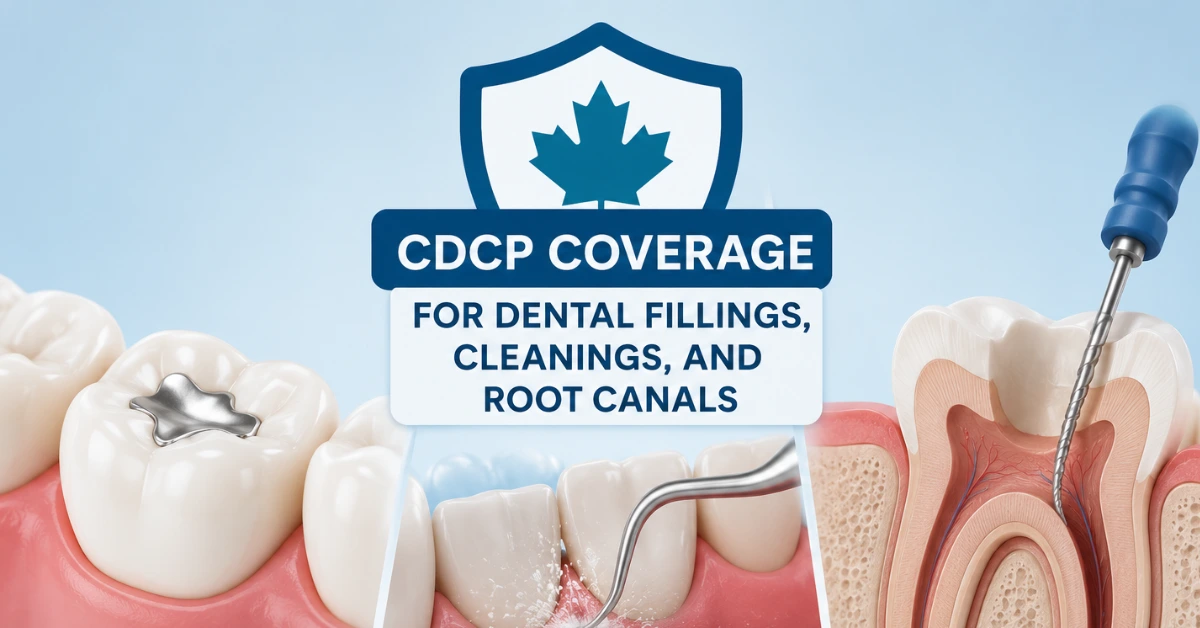
The Canadian Dental Care Plan (CDCP) is a federal program that covers a portion of dental costs for eligible Canadians who do not have private dental insurance and have an adjusted family net income under $90,000.
The good news for patients facing an emergency extraction: the CDCP covers oral surgery, including tooth extractions. Emergency exams are also covered under the plan’s diagnostic services. Here is what you need to know:
- No co-payment for eligible patients with an adjusted family net income under $70,000 – the CDCP covers the full CDCP fee for the service.
- 40% co-payment for eligible patients with income between $70,000 and $79,999.
- 60% co-payment for eligible patients with income between $80,000 and $89,999.
There is an important nuance worth understanding. The CDCP pays dentists according to its own federal fee guide, which is often lower than the ODA provincial fee guide. If the dental office charges at the ODA rate, you may owe the difference between the CDCP fee and the office fee, in addition to any co-payment. This is sometimes called balance billing. Always ask our team for a pre-determination of your costs before proceeding.
To use your CDCP benefits, confirm your coverage is active before your appointment and let our team know when you call. We participate in the CDCP and will direct-bill Sun Life on your behalf. Note that CDCP renewals for the 2026-2027 benefit year are open from April 15 to June 1, 2026 – if you have not renewed, confirm your coverage status before your visit.
If you have questions about whether you qualify for the CDCP, visit canada.ca/dental or call Service Canada at 1-833-537-4342.
Payment Options for Emergency Care
We understand that a dental emergency is rarely planned for – and an unexpected bill adds stress to an already difficult situation. At The Dental Team, we want cost to be a manageable concern, not a reason to delay necessary care.
Payment options available at our locations include:
- Direct insurance billing – We bill your insurance provider directly so you only pay your portion at the office.
- CDCP direct billing – We submit claims to Sun Life for CDCP members so you are not paying upfront and waiting for reimbursement.
- Credit and debit cards – Accepted at all locations, including Visa, Mastercard, and Interac.
- Third-party dental financing – Programs like Dentalcard allow eligible patients to spread the cost of treatment over time with low-interest payment plans.
- Health Spending Accounts (HSAs) – If your employer provides an HSA, tooth extractions qualify as an eligible medical expense.
- Tax deduction – Dental expenses exceeding the CRA threshold can be claimed as medical expenses on your Canadian tax return. Keep your receipts.
If you are facing financial hardship, speak with our front desk team when you call. An infected tooth will not improve on its own – getting care sooner protects both your health and your wallet.
What Is Included in Your Emergency Extraction Cost
One thing that surprises some patients is that the extraction fee itself does not cover everything in an emergency visit. Here is a clear picture of what your total bill typically includes:
- Emergency limited exam – A focused assessment of the problem area. This is not a full mouth exam and is billed separately.
- Diagnostic X-ray – One or more periapical images of the affected tooth. Sometimes a panoramic X-ray is needed if the situation is more complex.
- Local anesthetic – Included in the extraction fee. The area is fully numbed before any work begins.
- The extraction itself – Simple or surgical, depending on the tooth’s condition.
- Post-operative instructions – Verbal and written guidance on healing, diet, and when to call if something feels wrong.
- Gauze and basic aftercare supplies – Provided at the time of your visit.
What is not included in the emergency extraction fee:
- Optional sedation (nitrous oxide, oral sedation, IV sedation)
- Prescription pain medication or antibiotics (written by the dentist, filled at a pharmacy)
- Follow-up visits for socket check or complications
- Tooth replacement planning (implant, bridge, partial denture) – this is a separate conversation and appointment
How to Save on Emergency Dental Care
There are real ways to reduce your out-of-pocket cost for an emergency extraction without compromising your care.
- Call during regular office hours when possible. If your tooth is painful but not a crisis-level emergency – no spreading swelling, no fever – calling first thing in the morning for a same-day appointment can sometimes help you avoid after-hours fees.
- Use your insurance benefits strategically. If you are close to your annual maximum reset date, it may be worth understanding your timing. Most insurance years run January through December, and unused benefits do not carry over.
- Apply for the CDCP if you qualify. If you have no private dental insurance and your household income is under $90,000, the CDCP can cover a meaningful portion of emergency care. Apply or check your eligibility at canada.ca/dental before your next emergency happens.
- Be an established patient. As a regular patient at The Dental Team, we may already have recent X-rays on file for you, which can reduce diagnostic costs during an emergency visit.
- Ask about payment plans before committing. Do not let the assumption of a large upfront bill stop you from calling. Ask about financing options when you book – our team can walk you through what is available.
- Prevent emergencies with regular care. This sounds simple, but it is worth saying: a routine dental cleaning that catches a decaying tooth costs far less than the emergency extraction that becomes necessary six months later.
Frequently Asked Questions: Emergency Extraction Cost in Ontario
How much does an emergency tooth extraction cost in Ontario without insurance?
Without insurance, a typical emergency extraction visit in Ontario – including the emergency exam, one X-ray, and a simple extraction – runs between $350 and $550. A surgical extraction of a broken or impacted tooth will be higher, often $500 to $900 or more depending on complexity and whether sedation is used.
Is there an extra charge for an emergency dental visit vs. a regular appointment?
Yes, typically. An emergency visit includes an emergency exam fee ($80 to $150) and same-day X-rays ($40 to $80+) that may not be required at a scheduled appointment where recent diagnostics are already on file. Some practices also charge a time-of-service premium for after-hours or weekend appointments. The extraction fee itself is the same regardless of urgency.
Does dental insurance cover emergency tooth extractions?
Most private dental insurance plans in Ontario cover tooth extractions as a basic service, often at 70% to 100% of the ODA fee. Emergency exam fees and X-rays are typically covered under diagnostic benefits. The main variables are your annual maximum, whether you have used it, and whether any waiting periods apply to major services. Call your insurer or let our team submit a pre-determination before your visit.
Does the Canadian Dental Care Plan cover emergency extractions?
Yes. The CDCP covers oral surgery including tooth extractions, and emergency exams are covered under diagnostic services. Eligible patients with family income under $70,000 pay no co-payment on the CDCP fee amount. Those earning $70,000 to $79,999 pay a 40% co-payment, and $80,000 to $89,999 pay 60%. You must not have access to private dental insurance to qualify. Confirm your coverage is active before your appointment by checking your My Service Canada Account or calling 1-833-537-4342.
What if I cannot afford an emergency extraction?
Do not put off the call. Speak with our team about your situation when you contact us – we offer direct CDCP billing, third-party dental financing through programs like Dentalcard, and can discuss payment arrangements. An untreated dental infection does not stay contained – it can spread and become a much more serious and expensive medical problem. Getting seen quickly is almost always the more cost-effective choice.
Are there any government programs that cover emergency dental care in Ontario?
The CDCP is the primary federal program covering emergency dental care for eligible uninsured Canadians. In Ontario, Healthy Smiles Ontario covers emergency dental care for children and youth under 18 from eligible low-income families. Adults receiving Ontario Works or the Ontario Disability Support Program may have limited emergency coverage for pain relief. OHIP does not cover dental procedures performed in a dental office.
How do I know if I need an emergency extraction or a root canal?
Your dentist will make that determination based on your exam and X-ray. A tooth can often be saved with a root canal if the structure is intact and the surrounding bone is healthy. If the tooth is too broken, too infected, or not restorable, extraction may be the only option. Our team will explain your choices and their costs before proceeding with any treatment.
Book Emergency Dental Care at The Dental Team
A dental emergency is stressful enough without worrying about hidden fees or billing surprises. At The Dental Team, we believe in transparent pricing – you will know what your visit involves before we begin, and our team will help you understand your insurance or CDCP coverage at the time you call.
We offer same-day emergency dental care at our locations across Milton, Mississauga, and Brampton. Whether you need an urgent extraction or guidance on your next steps, our teams are here to help you get out of pain and back to your day.
Contact The Dental Team for more information about compassionate dental care services, or call your nearest location today.